
I love the 1939 Wizard of Oz. The moment when Dorothy steps out of the crashed farmhouse, moving from a dull sepia-toned world into the color-saturated world of Oz, always thrills me. Three-strip Technicolor in 1939 was an enormously complex and expensive process. It required a special bulky camera that essentially shot through three color filters …
I love the 1939 Wizard of Oz. The moment when Dorothy steps out of the crashed farmhouse, moving from a dull sepia-toned world into the color-saturated world of Oz, always thrills me. Three-strip Technicolor in 1939 was an enormously complex and expensive process. It required a special bulky camera that essentially shot through three color filters simultaneously, and the sets required lighting so intense that the cast frequently complained about the heat on set and eye irritation.
The storytelling instinct behind this was brilliant. By grounding Dorothy’s real world in drab, muted tones, the explosion into the vivid greens, yellows, and reds of Oz creates an almost visceral emotional impact on the viewer. It reinforces the idea that Oz is a place of wonder beyond ordinary experience—or possibly just a dream.
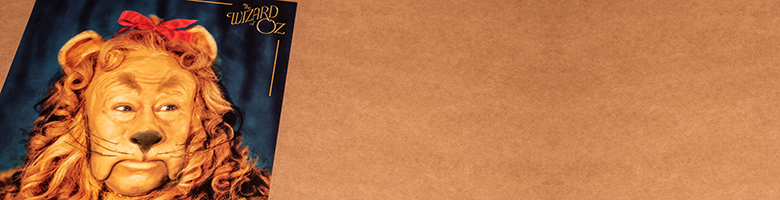
My favorite character is the Cowardly Lion. Bert Lahr’s Lion is a remarkable piece of work on two fronts. The Lion costume was extraordinarily elaborate and punishing to wear. It was made from real lion pelts and weighed around 90 pounds, which made performing in it physically grueling. The costume had to be dried out between takes because Lahr would sweat so profusely inside it.
Lahr came from vaudeville and burlesque, and it shows in the best possible way. His Lion is a masterpiece of comic timing built on a foundation of genuine pathos. What makes the performance endure is that Lahr never plays the Lion as merely funny. There’s real wounded pride underneath the bluster—a character who is genuinely embarrassed by himself—which gives the audience something emotionally true to connect with beyond the comedy.
The Cowardly Lion is also one of the more layered characters in the story, both in Baum’s original book and the film. The Lion believes he lacks courage, which he sees as the essential quality of his species. He’s ashamed of his own fear and seeks the Wizard to give him what he thinks he doesn’t have. The irony, of course, is that he demonstrates genuine courage repeatedly throughout the journey, facing danger despite being terrified—which is arguably a better definition of bravery than simply feeling no fear at all.
What the Lion lacks is confidence.
Courage and confidence are not the same thing. We use them almost interchangeably, but they point in completely different directions. Courage is the willingness to act when you don’t feel safe—when the outcome is uncertain, when the people around you might react badly, when saying the hard thing or making the hard call could cost you something. Courage lives in discomfort. It doesn’t wait for the conditions to be right.
Confidence is something else. Confidence is the place where we know what we know. It’s the familiar territory, the area of expertise, the conversation we’ve had a hundred times. There’s nothing wrong with confidence; leaders need it. The problem is that confidence can become a hiding place.
I’ve watched leaders (and I’ve been this leader) retreat into confidence when courage was what the moment required. It’s easy to stay in the lane where you’re skilled and certain. It feels like leadership. You’re decisive, you’re clear, you’re effective. But if the difficult conversation you keep not having lives just outside that lane, all the confident action inside it is just productive avoidance.
The Lion had real courage the whole time. He just didn’t recognize it because it didn’t feel the way he expected courage to feel. He thought courage was the absence of fear. What he had instead was the willingness to keep moving while afraid, which is the real thing.
The Wizard didn’t give the Lion anything he didn’t already have—he just named it.
Leaders don’t have the luxury of waiting for the Wizard. The people we serve need us to notice what is actually required—courage or confidence—and then choose accordingly. Sometimes that means stepping back from what we do well and stepping toward what makes us uncomfortable. It means having the conversation we’ve been engineering our schedule to avoid. It means being willing to be wrong, to be challenged, to not know. Confidence is good, but not when we let it stand in for courage. Knowing when to choose courage is the Bison Way.