Have you ever played “Super” Tic-Tac-Toe? I got to play with other leaders recently during an Advance Leadership Program where Jerry Magar was the presenter. The grid is 6x6 and the instructions are simple: each player picks a symbol, and you get a point for each 3-in-a-row—horizontal, vertical, or diagonal—and you fill in the entire …
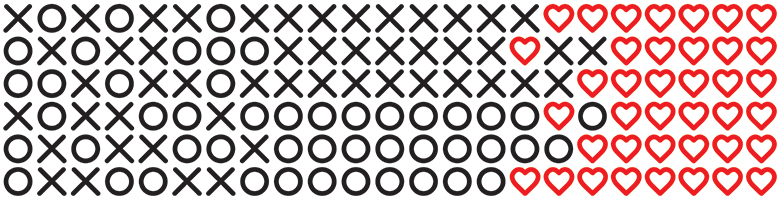
Have you ever played “Super” Tic-Tac-Toe? I got to play with other leaders recently during an Advance Leadership Program where Jerry Magar was the presenter. The grid is 6×6 and the instructions are simple: each player picks a symbol, and you get a point for each 3-in-a-row—horizontal, vertical, or diagonal—and you fill in the entire grid trying to get as many points as possible.
My game partner and I decided that if we agreed to fill in half the grid with our symbol and allow the other person to fill in the other half, we would each get 26 points, the maximum possible for each player in a two-player scenario. When Jerry said to start, we quickly filled in our grid and signaled that we were done. Unfortunately, a few other pairs had the same idea, so after the inevitable scores of 10, 12, 14, or even 16, we weren’t the only two with 26 points.
Then Jerry said something that stuck with me the rest of the day and is still in my head. What if we had both chosen the same symbol? The answer was 80 points.
The point of the exercise was to help us see the difference between an “us vs. them” mindset and a “team” mindset. Just like in tic-tac-toe, the world tends to parse everything as a competition. This stems from a fixed mindset, or what we might call a scarcity mentality. The mistaken idea is that there is only so much (you fill in the blank) to go around, and that for you to get some, someone else has to lose some.
What this game shows is that when we choose to be a single team, a single unit, one symbol, there are actually far more points available than when we compete—or even cooperate while remaining separate.
So how do we actually become one symbol? It starts with language.
Listen to how we talk in the spaces between meetings. “I sent it over to them.” “That’s a question for their department.” “We can’t move until they do.” The pronoun game is revealing. When we consistently use “us” and “them” to describe people inside the same organization, we are voting for separation. We are drawing a border that does not need to exist. Words are never just words. They build the map we navigate by.
The language shift is not complicated, but it is intentional. “I sent it over to our team in Dallas.” “Let me connect you with the right person here.” “What do we need to get this unstuck?” Same facts. Different world.
But language alone is just branding. Behavior has to follow.
When another team is struggling, the one-symbol response is to ask what you can do to help—not to stand back and feel relieved it is not your problem. When a win happens somewhere else in the building, the one-symbol response is to celebrate it like it happened on your floor—because it did. When you are deciding how to allocate time or resources, the one-symbol question is not “what is best for my group” but “what moves us all forward.”
This is harder than it sounds. We are wired to protect our tribe. The brain works that way. But the game showed us something the brain does not naturally compute. Sometimes the best thing you can do for your score is to stop caring about your score.
The scarcity mindset keeps score between teams. The abundance mindset counts points for the whole board. There is a kind of partnership that still keeps people separate. You do your half; I do mine. We cooperate and stay in our lanes. That got us to 26. Respectable. But 26 is not 80.
To get to 80, we have to stop thinking of ourselves as separate players who have agreed to be nice to each other. We have to start thinking of ourselves as one entity with a shared goal, shared success, and a shared symbol.
I believe we have the culture to do this. We talk about everyone having equal and intrinsic value. We talk about carrying each other. Now the question is whether we will let those beliefs rearrange the way we show up when the game is actually in front of us. Choosing one symbol is the Bison Way.